

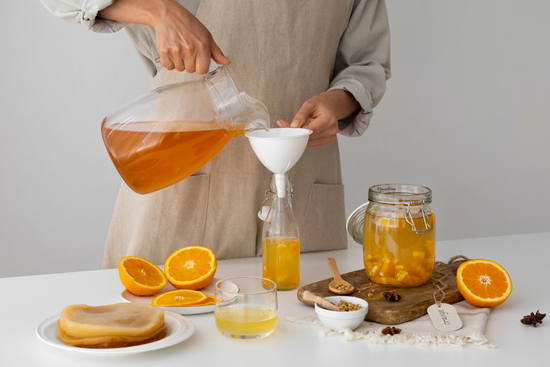
If you’ve wandered down the health food aisle in the last few years, you’ve probably seen those cloudy, faintly fizzy bottles with names like “ginger fire” or “hibiscus rose” sitting next to the kefir and cold-pressed juices. That’s kombucha, and it has quietly gone from a fringe health trend to a fixture in ordinary kitchens. Once you understand how to make kombucha yourself, you’ll probably wonder why you spent years paying four or five dollars a bottle for something you can brew at home for pennies.
This guide walks through everything worth knowing before your first batch: what kombucha actually is, where it came from, how it tastes, who should think twice before drinking it, whether it’s worth buying ready-made, and which brands are considered the gold standard if you’d rather not brew. Then we’ll get into the part you’re really here for — how to make kombucha with five recipes that range from the classic plain brew to fruitier, more adventurous flavors.
What Is Kombucha, Exactly?
Kombucha is a fermented, lightly effervescent tea. At its core, it’s nothing more exotic than sweetened black or green tea that’s been left to ferment with a living culture of bacteria and yeast. That culture is usually called a SCOBY — a Symbiotic Culture Of Bacteria and Yeast — though home brewers affectionately (or not so affectionately) call it “the mother,” “the mushroom,” or “the blob,” since it looks a bit like a pale, rubbery pancake floating in the jar.
During fermentation, the yeast in the SCOBY feeds on the sugar in the tea and produces carbon dioxide and trace amounts of alcohol, while the bacteria convert some of that alcohol into organic acids — mainly acetic acid, the same acid found in vinegar, along with smaller amounts of gluconic and lactic acid. The result is a tangy, slightly sour, faintly sweet drink with natural carbonation and a small population of beneficial bacteria and yeast strains. It’s this fermentation process that gives kombucha its reputation as a “living” drink, similar in spirit to yogurt, sauerkraut, or kefir.
Nutritionally, plain kombucha is fairly modest: roughly 30–60 calories per cup, depending on how much sugar remains after fermentation, along with small amounts of B vitamins and antioxidants carried over from the tea leaves. It’s not a superfood in the dramatic sense marketing sometimes implies, but it is a genuinely interesting fermented beverage with a loyal following for good reason.
Where Does Kombucha Come From? A Brief History
Kombucha’s origin story is tangled up in legend, which only adds to its appeal. The most commonly repeated account traces it back to Northeast China — historically referred to as Manchuria — around 220 BCE, during the Qin dynasty. One popular legend claims Emperor Qin Shi Huang, obsessed with immortality, prized a fermented tea believed to extend life, which some enthusiasts connect to what we now call kombucha, though the historical link is shaky at best.
The name itself likely comes from a different story entirely. According to one widely cited version, a Korean physician known as Dr. Kombu traveled to Japan in the early fifth century and treated the ailing Emperor Ingyō with a fermented tea. The doctor’s name, combined with “cha” — the word for tea across much of East Asia — eventually became “kombu-cha.”
From East Asia, the drink spread west along trade routes, eventually taking hold in Russia and Eastern Europe, where it became known as “tea kvass” or “tea mushroom.” European interest grew through the early twentieth century, and the beverage picked up steam in the West throughout the 1990s and 2000s, largely thanks to early commercial brewers who began bottling it for grocery store shelves. Today it’s a multi-billion-dollar global category, but the process itself — tea, sugar, a live culture, and patience — hasn’t changed much in over two thousand years.
What Does Kombucha Taste Like?
This is usually the first question anyone asks before trying it, and it’s a fair one, because kombucha doesn’t taste like much else on a grocery shelf. Expect something tart and slightly vinegary, similar to a dry apple cider vinegar softened with tea and a touch of residual sweetness. There’s usually a gentle fizz, somewhere between sparkling water and a mild soda, and a faint yeasty, bready note underneath from the fermentation itself.
Plain, unflavored kombucha tends to be the most polarizing — some people love its sharp, clean tang, while others find it too sour or vinegary on the first try. Flavored versions, especially those made with fruit, ginger, or herbs, tend to be far more approachable for newcomers, since the added sweetness and aromatics soften the acidity. If your first sip is a little jarring, it’s worth trying a fruitier variety before writing the whole category off — plenty of devoted kombucha drinkers started out unimpressed and came around after a second or third attempt with a different flavor.
What Is Kombucha Good For? Potential Benefits
Kombucha’s popularity rests largely on its status as a fermented, probiotic-rich beverage, and there’s reasonable evidence to support some — though not all — of the claims made about it.
- Gut health support. Like other fermented foods, kombucha contains live bacterial cultures that may contribute to a more diverse gut microbiome when consumed regularly as part of a varied diet.
- Antioxidant content. Tea, especially green tea, is naturally rich in polyphenols, and some of these compounds carry over into the finished kombucha.
- A lower-sugar alternative to soda. Because much of the original sugar is consumed during fermentation, a well-brewed kombucha usually contains noticeably less sugar than a typical soft drink.
- Small amounts of B vitamins. Yeast fermentation naturally produces trace B vitamins, including B1, B6, and B12, though the amounts are generally too small to rely on as a primary source.
- A caffeine-light pick-me-up. Because kombucha is brewed from tea, it retains a modest amount of caffeine — typically less than a cup of coffee — which some people enjoy as a gentler alternative.
It’s worth being honest about the limits here: much of the research on kombucha’s specific health effects is still preliminary, based on small studies or laboratory work rather than large human trials. It’s reasonable to enjoy kombucha as a flavorful, lower-sugar, probiotic-containing beverage without expecting it to cure anything on its own.
Who Should Avoid Kombucha? Contraindications to Know
Kombucha is generally considered safe for most healthy adults in moderate amounts, but it isn’t the right choice for everyone. A few groups in particular should be cautious or avoid it altogether:
- Pregnant and breastfeeding people. Kombucha naturally contains trace amounts of alcohol produced during fermentation — typically under 0.5%, though home-brewed batches can occasionally exceed that — along with caffeine. Because it’s often unpasteurized, it also carries a small risk of contamination with harmful bacteria, which is why most healthcare providers recommend avoiding it during pregnancy and while nursing.
- People with compromised immune systems. Since raw kombucha isn’t pasteurized, anyone who is immunocompromised, undergoing chemotherapy, or otherwise more vulnerable to foodborne illness should speak with a doctor before drinking it.
- Anyone with a yeast or mold sensitivity. The SCOBY itself is a yeast and bacteria culture, and while a healthy, well-maintained brew is safe, an improperly cared-for one can develop harmful mold.
- People sensitive to caffeine. Kombucha typically contains far less caffeine than brewed tea, but it isn’t caffeine-free, so anyone highly sensitive should factor that in.
- People managing blood sugar closely. Store-bought kombucha can vary widely in sugar content, and even home-brewed batches retain some residual sugar, so it’s worth checking labels or tasting for sweetness if this is a concern.
- Anyone in recovery from alcohol use disorder. Because of the trace alcohol content, some people in recovery choose to avoid kombucha entirely as a precaution.
None of this makes kombucha dangerous for the average healthy adult — it simply means it’s worth a quick check with a doctor if you fall into one of these categories, the same way you’d double-check any fermented or unpasteurized food.
Can You Buy Ready-Made Kombucha in Stores?
Yes, and in most supermarkets today it’s easier to find bottled kombucha than it is to find some far more established drinks. What started as a niche item in health food stores has moved firmly into the mainstream — most large grocery chains now stock a refrigerated kombucha section, often with a dozen or more brands and flavors side by side. It’s also common to find it at cafes, juice bars, and even on tap at some restaurants and taprooms, poured fresh like a craft beer.
Buying kombucha ready-made is obviously the more convenient option if you just want to try it without committing to a multi-day brewing process. The tradeoff is cost — a single bottle can run anywhere from three to six dollars, which adds up quickly if it becomes a daily habit — and less control over sugar content, since some commercial brands sweeten their kombucha after fermentation to make the flavor more consistent. Learning how to make kombucha at home sidesteps both of those issues, letting you control the sugar, the flavor, and the strength of the fermentation, usually for a fraction of the price per bottle.
The Most Trusted Kombucha Brands: A Quick Comparison
If you’d rather buy than brew, or just want a benchmark to compare your homemade batches against, these five brands consistently show up at the top of taste tests and industry rankings.
| Brand | Known For | Flavor Profile | Best For |
|---|---|---|---|
| GT’s Living Foods (Synergy) | The original mainstream kombucha brand, launched in 1995 | Bold, vinegary, classic kombucha tang | Purists who want the strongest fermentation character |
| Health-Ade | Small-batch glass-bottled kombucha with a wide flavor range | Balanced and fruit-forward | Newcomers who want an approachable entry point |
| Brew Dr. Kombucha | Tea-forward brewing using whole-leaf tea blends | Smooth, less sour, herbal undertones | People who find plain kombucha too sharp |
| Humm Kombucha | Budget-friendly, widely available multipacks | Light, mildly sweet | Everyday drinkers who want value |
| KeVita | Mass-market distribution, found in gas stations and airports | Very mild, easy-drinking | Grab-and-go convenience over intensity |
Tastes vary enormously from one brand to the next, so it’s worth trying a few before deciding on a favorite — the difference between a “vinegary” brand and a “smooth” one can be surprising for a first-time drinker.
Kombucha vs. Kefir vs. Kvass: How Do They Compare?
Kombucha often gets lumped together with other fermented drinks, but each one is made differently and tastes distinct. If you’re deciding what to try first, here’s how the three most common options stack up.
| Drink | Base Ingredient | Fermentation Culture | Flavor | Typical Alcohol Content |
|---|---|---|---|---|
| Kombucha | Sweetened black or green tea | SCOBY (bacteria + yeast) | Tart, vinegary, lightly fizzy | Under 0.5% |
| Water kefir | Sugar water | Kefir grains (bacteria + yeast) | Mild, faintly tangy, very fizzy | Trace amounts |
| Kvass | Fermented bread or beets | Wild yeast and bacteria | Earthy, slightly sour, bready | Usually under 1% |
Water kefir is the closest relative to kombucha in terms of process, though it uses different cultures and tends to have a milder, less acidic flavor. Kvass, popular across Eastern Europe, is fermented from bread or root vegetables rather than tea, giving it an earthier, heartier character. All three fall into the same general category of low-alcohol, probiotic-rich fermented beverages, but kombucha remains the most widely available and the easiest to flavor at home.
Kombucha Fun Facts Worth Knowing
- The SCOBY is technically a form of cellulose, and some designers have experimented with growing large sheets of it to create a leather-like fabric for clothing and accessories.
- A healthy SCOBY can produce “babies” with every batch, meaning one starter culture can theoretically keep a household supplied with kombucha indefinitely — and gift a friend a new hobby in the process.
- Despite modern marketing, kombucha predates almost every soft drink on grocery shelves today by well over two thousand years.
- Commercial kombucha in the United States is legally capped at 0.5% alcohol by volume to be sold as a non-alcoholic beverage, which is why some brands remove excess alcohol before bottling.
- Kombucha vinegar — an intentionally over-fermented batch — can be used in salad dressings and marinades just like any other vinegar, so a batch that ferments too long isn’t necessarily wasted.
- The flavor and strength of kombucha can shift noticeably with the seasons, since warmer room temperatures speed up fermentation and cooler ones slow it down.
How to Make Kombucha: What You’ll Need Before You Start
Before jumping into the recipes, it helps to gather the basics. Learning how to make kombucha at home really only requires a handful of tools and ingredients, most of which you likely already have or can find cheaply.
Equipment:
- A large glass jar (at least one gallon), never metal or plastic, since the acidity can react with certain materials
- A tightly woven cloth or coffee filter, plus a rubber band, to cover the jar while allowing airflow
- A SCOBY with at least one cup of starter liquid (from a previous batch, a store-bought bottle of raw kombucha, or a friend who brews)
- Glass bottles with airtight flip-top lids for the second fermentation
- A funnel and fine-mesh strainer
Ingredients (per gallon batch):
- 8–14 bags of black, green, or a blend of both teas (avoid flavored or oily teas like Earl Grey, which can harm the SCOBY over time)
- 1 cup of white granulated sugar (the SCOBY needs real cane sugar to ferment properly — honey, artificial sweeteners, and raw agave are not reliable substitutes)
- Filtered or dechlorinated water (chlorine can inhibit the culture)
- A SCOBY and starter liquid
A quick note on temperature: kombucha ferments fastest in warm rooms, ideally 68–78°F. If your kitchen runs cooler in winter, expect fermentation to take longer, and consider moving the jar to a warmer spot like the top of a refrigerator or near (but not touching) a heating vent. There’s no need to buy specialty organic sugar or loose-leaf tea for a good result — plain white sugar and basic bagged black tea work perfectly well and are exactly what most commercial brewers rely on, too. Save the fancier ingredients for once you’ve got a feel for the process.
With that groundwork covered, here’s how to make kombucha with five different approaches — one classic base recipe and four flavored variations built on top of it.
How to Make Kombucha: 5 Easy Recipes
Each of these recipes starts from the same basic sweet tea base and diverges at the flavoring stage, which happens during a second, shorter fermentation. This two-step method — a long first ferment to brew the tea into kombucha, followed by a short second ferment with fruit or spices for flavor and fizz — is the standard approach used by most home brewers and commercial producers alike.
Recipe 1: Classic Original Kombucha
This is the foundational recipe every other one builds on, and it’s the best starting point if you’ve never brewed before.
Ingredients: 1 gallon filtered water, 1 cup sugar, 8 bags black tea, 2 cups starter liquid, 1 SCOBY
Method:
- Bring the water to a boil, remove from heat, and stir in the sugar until fully dissolved.
- Add the tea bags and steep for 10–15 minutes, then remove them.
- Let the sweet tea cool completely to room temperature — adding a warm liquid to the jar can damage the SCOBY.
- Pour the cooled tea into your glass jar, add the starter liquid, and gently place the SCOBY on top.
- Cover with cloth, secure with a rubber band, and store in a warm, dark spot (68–78°F) away from direct sunlight for 7–14 days.
- Taste-test starting on day 7 using a straw; once it hits the balance of tart and sweet you like, it’s ready to bottle or flavor.
Recipe 2: Ginger Kombucha
Ginger is the classic second-fermentation flavor for a reason — it adds warmth, a bit of heat, and noticeably stronger carbonation.
Ingredients: 1 batch first-fermentation kombucha (from Recipe 1), 1–2 tablespoons freshly grated ginger per bottle
Method:
- Strain the finished first-fermentation kombucha, setting the SCOBY aside in some starter liquid for your next batch.
- Add the grated ginger directly into each flip-top bottle.
- Fill each bottle with kombucha, leaving about an inch of headspace, and seal tightly.
- Leave at room temperature for 2–4 days to build carbonation, then strain out the ginger if you prefer a smoother texture and refrigerate.
Recipe 3: Strawberry Kombucha
A crowd-pleasing, naturally sweet option that’s especially good for people trying kombucha for the first time.
Ingredients: 1 batch first-fermentation kombucha, 1/2 cup mashed or pureed fresh strawberries per bottle
Method:
- Strain your finished kombucha as above.
- Divide the strawberry puree evenly between your bottles.
- Top with kombucha, seal, and let ferment for 2–3 days at room temperature.
- Strain through a fine mesh strainer before drinking if you’d rather avoid the pulp, then chill.
Recipe 4: Blueberry Lavender Kombucha
A slightly more elevated flavor pairing that works beautifully for warm-weather sipping.
Ingredients: 1 batch first-fermentation kombucha, 1/3 cup mashed blueberries and 1/2 teaspoon dried culinary lavender per bottle
Method:
- Strain the finished kombucha.
- Add the mashed blueberries and lavender to each bottle.
- Seal and ferment for 2–4 days, checking daily for the level of fizz you prefer.
- Strain and refrigerate before serving; the lavender flavor intensifies the longer it sits, so start with a light hand.
Recipe 5: Mango Passionfruit Kombucha
A tropical, slightly tart-sweet combination that tends to convert even skeptics.
Ingredients: 1 batch first-fermentation kombucha, 1/3 cup pureed mango and 2 tablespoons passionfruit pulp per bottle
Method:
- Strain the finished kombucha as before.
- Combine the mango and passionfruit and divide between bottles.
- Seal and ferment 2–4 days at room temperature.
- Strain if desired, then refrigerate for at least a few hours before opening — this flavor tends to build noticeable pressure, so open bottles carefully over a sink.
Tips for Perfect Kombucha Every Time
- Keep everything metal away from the SCOBY. Stick to plastic or wooden utensils when handling it, since prolonged contact with metal can weaken the culture.
- Always taste before bottling. The right fermentation length depends on your climate and personal taste, so don’t rely on the clock alone — a straw taste-test is the most reliable indicator.
- “Burp” your bottles during the second ferment. Opening the lid briefly once a day releases excess pressure and reduces the risk of a bottle overflowing or, rarely, breaking.
- Save starter liquid every time. A cup or two of finished kombucha from your last batch keeps the acidity right for the next one and helps prevent mold.
- Be patient with new SCOBYs. A freshly grown or purchased culture may take a batch or two to hit its stride, so don’t judge the whole process on your very first attempt.
Storing and Serving Kombucha
Once your kombucha is bottled and flavored to your liking, moving it to the refrigerator is what effectively “pauses” fermentation — cold temperatures slow the yeast and bacteria down dramatically, so a chilled bottle will change very little over the following weeks. Most home-brewed kombucha keeps well in the fridge for a month or more, though the flavor will keep evolving slowly, growing slightly more tart over time.
Serve it straight over ice, mix it with sparkling water to stretch a batch further, or use it as a mixer in place of soda in mocktails and cocktails alike — its acidity plays especially well with gin, tequila, and fresh citrus. If a bottle has built up a lot of pressure, open it slowly over a sink with a towel wrapped around the cap, the same way you’d open a bottle of homemade ginger beer, just in case it fizzes over.
Common Mistakes to Avoid
Even once you’ve got the basic process down, a few missteps trip up most beginners learning how to make kombucha for the first time:
- Using tap water without letting the chlorine dissipate first, which can weaken or kill the culture
- Skipping the cooling step and adding hot tea directly to the SCOBY
- Fermenting in a spot that’s too cold, which slows fermentation dramatically and can lead to a flat, overly sweet batch
- Sealing bottles too early in the second fermentation without burping them, risking overflow
- Using a jar that’s been previously used for cleaning products or strong-smelling foods, which can transfer unwanted flavors or residue
Frequently Asked Questions
Is it hard to learn how to make kombucha at home?
Not really. Once you understand the two-step process — a long first ferment for the tea, then a short second ferment for flavor and fizz — it becomes a simple, repeatable routine. The hands-on time is minimal; most of the work is just waiting.
How long does a batch of kombucha take from start to finish?
Plan on 7–14 days for the first fermentation and another 2–4 days for flavoring and carbonation, so roughly 10–18 days total depending on your kitchen’s temperature and how tangy you like the final result.
Where can I get a SCOBY to start brewing?
You can buy one online from a reputable fermentation supplier, get one from a friend who already brews (SCOBYs multiply with every batch), or grow your own from a bottle of raw, unflavored, unpasteurized store-bought kombucha, though this method takes longer and isn’t guaranteed to work.
Does homemade kombucha contain alcohol?
Yes, but only in trace amounts, typically well under 1%, produced naturally as a byproduct of fermentation. It’s not considered an alcoholic beverage, though anyone who needs to avoid alcohol entirely should be aware it isn’t completely alcohol-free.
Why is my kombucha not fizzy?
Carbonation builds during the sealed second fermentation, so an under-carbonated batch is usually a sign it needs more time at room temperature, a tighter seal, or slightly more sugar from added fruit to fuel the yeast.
Can I flavor kombucha without a second fermentation?
Yes — you can simply stir fruit, juice, or herbs into finished kombucha right before drinking. You’ll lose the extra fizz that a sealed second ferment builds, but it’s a quick way to experiment with flavors before committing a whole batch.
How do I know if my SCOBY has gone bad?
A healthy SCOBY can look strange — pale, stringy, or lumpy — and that’s normal. The real warning sign is fuzzy mold, usually black, blue, or bright green, growing on top rather than the brownish yeast strands that naturally form within the liquid. When in doubt, it’s safer to discard the batch and start fresh.
Once you’ve made your first batch, the rest tends to come easily — most home brewers find that after learning how to make kombucha even one time, they never go back to buying it by the bottle. Start with the classic recipe, get comfortable with the timing in your own kitchen, and then use the flavored versions here as a launching point for whatever fruit or herbs you have on hand.