

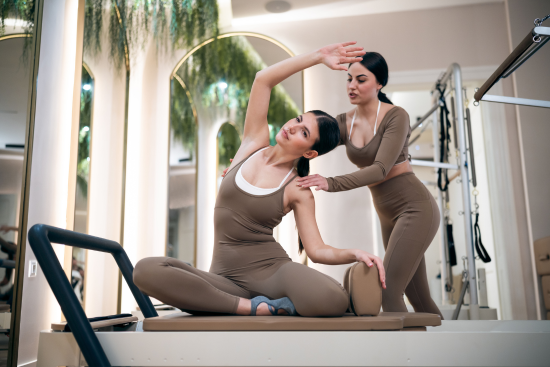
If you’ve ever walked past a Pilates studio and seen people lying on a strange bed-like contraption pulling on straps and pushing against a sliding platform, you’ve probably wondered the same thing most newcomers do: what is reformer Pilates good for, exactly, and is it worth the price tag compared to a mat class you could do at home for free? It’s a fair question. Reformer classes usually cost more than mat sessions, the equipment looks intimidating, and the marketing around it can be vague — lots of talk about “lengthening” and “toning” without much substance behind it.
This guide is meant to cut through that. We’ll walk through what the reformer machine actually does to your body, how it differs from mat Pilates (and whether that difference is real or just marketing), twelve concrete benefits backed by how the equipment works, who tends to get the most out of it, whether it can help with weight loss, and roughly how long it takes before you notice a difference. By the end, you should have a clear, honest answer to what is reformer pilates good for — not just a sales pitch.
What Is Reformer Pilates, Exactly?
The reformer is a piece of equipment invented by Joseph Pilates himself, originally built from a hospital bed frame and springs to help injured soldiers rebuild strength during World War I. The core design hasn’t changed much: a sliding carriage moves along a frame, resisted by a set of springs you can adjust for more or less tension. You push or pull the carriage using straps, a bar, or your own feet, while your body stays braced against the moving platform.
That combination — a moving surface plus adjustable resistance — is what separates reformer work from almost every other form of exercise. On a stable floor, gravity is your only resistance, and your job is to control your own body weight. On the reformer, the platform underneath you is also moving, so your stabilizing muscles have to work constantly just to keep you balanced, on top of whatever the working muscle is doing. That’s a big part of the answer to what is reformer pilates good for: it trains coordination and control at the same time as strength, which a static surface simply can’t replicate.
Mat Pilates vs. Reformer Pilates: Is There Really a Difference?
This is where a lot of confusion lives, so let’s be direct about it: yes, there is a real, measurable difference, but it’s not that one is “better” and the other is “worse.” They’re built around the same principles — controlled breathing, core engagement, precise movement — but the tools change what your body actually experiences.
Mat Pilates relies entirely on gravity and your own body weight. It’s excellent for building core control, teaching the fundamentals of Pilates breathing, and improving body awareness. It’s also free, portable, and requires no equipment beyond a mat, which makes it easy to fit into daily life.
Reformer Pilates adds external, adjustable resistance through springs, plus an unstable moving surface. This changes the exercise in two important ways. First, the springs let you add or subtract load, which means the same exercise can be made harder as you get stronger — something mat Pilates struggles to do without added props. Second, the moving carriage forces your stabilizing muscles (deep core, hips, shoulder girdle) to work continuously, which is genuinely difficult to replicate on a fixed floor.
So does reformer Pilates give better results? For pure strength and muscle engagement, most instructors and physical therapists agree the reformer has an edge, simply because it offers progressive resistance and works more muscle groups per exercise. For flexibility, breathing control, and the mind-body fundamentals, mat Pilates holds its own and, for many people, is the better starting point before moving to the reformer. In practice, the two complement each other rather than compete — a lot of long-term practitioners do both.
| Mat Pilates | Reformer Pilates | |
|---|---|---|
| Equipment needed | Mat only | Reformer machine |
| Resistance | Body weight only | Adjustable springs |
| Surface | Fixed floor | Moving carriage |
| Cost | Free / low-cost apps or classes | Studio membership or home machine |
| Best for | Beginners, core basics, flexibility | Full-body strength, rehab, progressive challenge |
| Typical calorie burn (60 min) | Roughly 175–250 | Roughly 200–450 |
| Learning curve | Low | Moderate (needs guidance early on) |
What to Expect in Your First Reformer Pilates Class
Walking into your first reformer session can feel a little intimidating — the machine has straps, pulleys, a sliding carriage, and a headrest that all look like they belong to a piece of gym equipment from a different decade. In practice, a good instructor will spend the first few minutes just orienting you: how to get on and off the carriage safely, how the springs work, and what the color-coding on the resistance means (usually, though it varies by brand, lighter springs are for higher-resistance leg work and heavier springs are for lower-resistance arm work, which surprises a lot of newcomers).
Expect the pace to be slower and more deliberate than a typical gym class. Reformer instructors spend a lot of time on cueing — reminding you to keep your shoulders down, your ribs pulled in, your spine in a neutral position — because the exercises only deliver their benefit when done with correct alignment. It’s common to feel like you’re “not doing much” in your first class, only to wake up the next day sore in places you didn’t expect, particularly the deep core and inner thighs. That delayed soreness is normal and tends to fade noticeably by the third or fourth session as your stabilizing muscles adapt.
What Is Reformer Pilates Good For? 12 Real Benefits
Here’s the core of it. Below are twelve concrete, physically explainable benefits of reformer Pilates — not vague wellness language, but specific things the equipment is designed to do.
1. Full-Body Strength Without Heavy Weights
Because the springs provide constant, adjustable tension, reformer exercises load your muscles through a full range of motion rather than just at the top of a lift the way a dumbbell might. This builds strength in the legs, arms, back, and core simultaneously, without the joint stress that comes with heavier free weights.
2. Genuine Core Stability, Not Just “Ab Work”
Almost every reformer exercise, even ones targeting the legs or arms, requires you to brace your core to keep your body stable on the moving carriage. This is a big part of what is reformer pilates good for when people mention “core strength” — it’s not sit-ups, it’s your deep core muscles firing constantly to keep you steady.
3. Improved Posture
Reformer work emphasizes spinal alignment in almost every exercise, and it strengthens the postural muscles along the back and shoulders that tend to weaken from sitting at a desk all day. Regular practice tends to translate into standing and sitting taller without consciously trying.
4. Better Flexibility Without Overstretching
The carriage assists and resists movement at the same time, which lets you move through a full range of motion with support, rather than forcing a stretch cold. This is one reason physical therapists sometimes use reformers in rehab — it allows controlled, assisted stretching that’s harder to achieve safely on a mat alone.
5. Low-Impact Joint Protection
Because the carriage glides rather than requiring you to jump, run, or land, reformer Pilates puts very little stress on the knees, hips, and spine. It’s a common recommendation for people recovering from injury or managing joint pain, precisely because it builds strength without impact.
6. Better Balance and Coordination
The unstable moving surface trains your proprioception — your body’s sense of where it is in space — in a way that few other workouts do outside of specific balance training. Over time, this shows up as steadier movement in everyday life, not just in the studio.
7. Muscle Toning and Lean Definition
Because reformer exercises work muscles through long, controlled ranges of motion under constant tension, rather than short, explosive bursts, the visible effect tends to be leaner, more defined muscle rather than bulk. This is often the single most-asked-about benefit, and it’s a legitimate one, though it takes consistency to show.
8. Support for Weight Management
A single session burns a meaningful number of calories — generally somewhere between 200 and 450 depending on intensity and session length — and the muscle built through regular practice raises resting metabolic rate over time. We go into more detail on this below, since it deserves its own section.
9. Reduced Back Pain
Several of the reformer’s signature exercises target the deep spinal stabilizers and the muscles around the pelvis, which are frequently underdeveloped in people with chronic low back pain. Many physiotherapists incorporate reformer-style resistance work into back rehab programs for exactly this reason.
10. Stress Reduction Through Controlled Breathing
Pilates as a system is built around a specific breathing pattern that’s synchronized with movement. On the reformer, where the spring resistance demands your full attention, that breathing focus tends to be even more pronounced, which has a genuine calming effect on the nervous system similar to what’s seen in other controlled-breathing practices.
11. Injury Rehabilitation and Prevention
The adjustable resistance and supported movement make the reformer a common tool in physical therapy clinics, not just fitness studios. It allows very precise loading — you can start with almost no resistance and build up gradually as an injury heals, which is much harder to do safely with body-weight-only mat work.
12. Scalable Difficulty for Every Fitness Level
Because the spring tension is adjustable and the same machine can be used for a beginner’s first class or an advanced athlete’s strength session, reformer Pilates scales in a way that few workouts do. This is arguably the most practical answer to what is reformer pilates good for over the long term — it grows with you instead of becoming too easy after a few months.
Common Mistakes Beginners Make on the Reformer
Even with an instructor present, a few habits tend to show up repeatedly among people new to the reformer, and knowing them ahead of time can shortcut a lot of frustration.
Choosing too much resistance too early. It’s tempting to add spring tension to feel like you’re “working harder,” but heavier springs often make it easier to cheat the movement using momentum instead of control, which defeats the purpose. Lighter resistance with strict form builds more real strength than heavy resistance with sloppy technique.
Holding your breath. Pilates breathing is meant to be continuous and coordinated with movement, but under the effort of resisting a spring, a lot of beginners unconsciously hold their breath, which increases tension in the neck and shoulders and makes the exercise harder than it needs to be.
Letting the ribs pop up. A very common cue in reformer classes is “ribs down,” because as the arms or legs move against resistance, it’s easy to let the lower ribs flare and the lower back arch, which shifts the work away from the core and onto the spine. This is one of the most frequent form corrections instructors give, and it’s worth paying attention to even after you’ve been practicing for a while.
Rushing the transitions. Part of what is reformer pilates good for is the controlled, unhurried nature of the movements, and beginners often rush between exercises out of habit from other gym formats. Slowing down the transitions themselves is often where a lot of the stability benefit actually comes from.
Studio vs. Home Reformer: Which Is Actually Worth It?
Once you’re convinced of what is reformer pilates good for, the next question is usually practical: should you join a studio, or buy a reformer for home use?
Studio classes offer a big advantage that’s easy to underestimate: a trained instructor correcting your form in real time. Reformer exercises rely heavily on precise alignment, and it’s genuinely easy to develop bad habits — like letting your lower back arch or your shoulders creep up — without someone watching. Studios also tend to have several reformer models and add-ons (jumpboards, towers) that a home machine may not include, and the shared-class energy helps some people stay consistent.
Home reformers remove the two biggest barriers to consistency: cost per session and scheduling. A single studio class often runs $25–$45, which adds up fast if you’re going two or three times a week, while a home reformer is a one-time cost that pays for itself within a few months of regular use. There’s also no commute, no booking window, and no risk of a class filling up — which matters more than people expect, since the research on this is fairly consistent: showing up regularly matters more for results than any single “harder” session.
In practice, a hybrid approach works well for a lot of people: a handful of studio sessions early on to learn correct form, followed by a home machine for day-to-day consistency, with the occasional studio class to check in on technique. If budget or space forces a choice, beginners generally benefit more from starting in a studio, even briefly, before investing in home equipment.
Reformer Pilates and Muscle Groups: What Actually Gets Trained
One more piece worth understanding before we talk about who it suits: unlike a lot of gym splits that isolate “leg day” or “arm day,” almost every reformer exercise recruits multiple muscle groups at once, layered around a stabilized core. A footwork sequence at the start of a typical class, for example, primarily targets the quadriceps, hamstrings, and glutes, but because your pelvis has to stay level and your spine has to stay neutral against the moving carriage, your deep core and even your shoulder stabilizers are quietly working the entire time.
Upper-body work — rows, chest presses, arm circles using the straps — trains the back, shoulders, and arms while your legs and core brace against the carriage to keep it from sliding uncontrollably. Long-box and kneeling exercises bring in the hips and glutes with an added balance challenge. This layered, whole-body engagement is part of why a 45-minute reformer class can feel more comprehensive than a 45-minute session on a single gym machine, even though the visible movement often looks small and controlled rather than big and explosive.
Who Is Reformer Pilates Good For?
This is where the answer to what is reformer pilates good for gets personal, because it genuinely suits a wide range of people, but for different reasons.
- Complete beginners to exercise: The low-impact nature and adjustable resistance make it a safe entry point, even for people who haven’t exercised regularly in years.
- Older adults: The balance and joint-friendly training is particularly valuable for maintaining mobility and reducing fall risk.
- Postpartum women: Reformer work is commonly used to rebuild core and pelvic floor strength gradually, though it’s worth checking with a doctor or pelvic floor specialist before starting.
- Athletes: Many runners, cyclists, and strength athletes use reformer sessions to build the stabilizing muscles their main sport doesn’t train, which helps prevent injury.
- People recovering from injury: Under the guidance of a physical therapist, the adjustable, low-impact resistance is genuinely useful for safe rehab.
- Desk workers with postural issues: The strong postural focus directly counteracts the effects of long hours sitting.
- People who find mat Pilates “too easy”: Once bodyweight core work stops being challenging, the reformer’s adjustable springs give you somewhere to go.
The main group that should be cautious is anyone with an acute, undiagnosed injury or a serious cardiovascular condition — not because reformer Pilates is risky, but because any new exercise program in those cases deserves a conversation with a doctor first.
Does Reformer Pilates Help You Lose Weight?
Short answer: yes, but not primarily through the calorie burn during the class itself, and it’s worth being honest about that instead of overselling it.
A typical 45- to 60-minute reformer session burns somewhere in the range of 200 to 450 calories, depending on your body weight, the intensity of the class, and how it’s programmed — a solid, moderate-intensity workout, but not dramatically higher than a brisk walk or a spin class, and lower than an hour of running. Where the reformer earns its reputation for weight management is what happens between sessions. Building lean muscle raises your resting metabolic rate, meaning your body burns more energy even when you’re not exercising. Studies looking at consistent reformer practice over 8 to 12 weeks have found measurable improvements in body composition, even among people who didn’t significantly change their diet.
There’s also a less obvious factor: consistency. Because reformer Pilates is low-impact and doesn’t leave you as physically wrecked as a heavy strength session or a long run might, people tend to stick with it longer, and long-term consistency is one of the strongest predictors of sustained weight change in the research on exercise adherence. So if the question is whether reformer Pilates can help you lose weight, the honest answer is that it can, largely by building the kind of muscle and habit that supports fat loss over months, rather than by torching an unusually high number of calories in any single class.
How Long Until You See Results?
This is one of the most common follow-ups to what is reformer pilates good for, and the honest answer depends on what “results” means to you.
- Weeks 1–2: You’ll likely notice better body awareness and less soreness after each session as your stabilizing muscles adapt. Don’t expect visible change yet — this stage is mostly neurological, your nervous system learning to recruit the right muscles.
- Weeks 3–4: Posture improvements often become noticeable to you and sometimes to people around you. Core strength improves enough that everyday movements — carrying groceries, bending to tie shoes — start to feel easier.
- Weeks 6–8: This is typically when visible muscle tone starts to show, particularly through the abdomen, arms, and legs, assuming you’re practicing two to three times a week. Flexibility gains are usually noticeable by this point too.
- Weeks 10–12 and beyond: Body composition changes become more consistent and measurable, and for most people this is where reformer Pilates starts to meaningfully support weight management goals if that’s part of the aim.
The consistent thread across most instructor and physical therapy guidance is that two to three sessions per week, sustained for at least two to three months, is where reformer Pilates delivers its clearest results — both for strength and for any weight-related goals.
How Reformer Pilates Fits Into a Broader Fitness Routine
One question that doesn’t get asked often enough is whether reformer Pilates should stand alone or work alongside other training. For most goals, it works best as a complement rather than a total replacement. If cardiovascular fitness is a priority, reformer sessions won’t replace running, cycling, or swimming, since the heart-rate demand is generally lower and more sustained rather than peaked. If maximal strength or muscle size is the goal, traditional weight training with progressively heavier loads will build size faster than spring resistance alone.
Where reformer Pilates shines is as the connective tissue between other types of training: it builds the core stability and joint control that make heavier lifting safer, the flexibility that keeps runners and cyclists from tightening up, and the postural strength that undoes hours of sitting. A lot of strength coaches and physical therapists recommend one or two reformer sessions a week alongside a primary training routine, rather than choosing one over the other, precisely because the benefits are largely non-overlapping.
A Few Interesting Facts About Reformer Pilates
- The reformer was originally built by Joseph Pilates from an actual hospital bed frame, using bed springs for resistance, to help bedridden patients maintain strength during recovery.
- Despite looking modern, the core design of the reformer has barely changed in almost a century — the same sliding carriage and spring system Joseph Pilates built is still the basis for machines used in studios today.
- Joseph Pilates originally called his method “Contrology,” emphasizing control over the body rather than raw effort — a philosophy that’s still central to how reformer classes are taught.
- Reformer Pilates is used in professional dance and sports rehabilitation programs specifically because it allows very fine-tuned, gradual increases in resistance during recovery.
- A single reformer machine typically has around 3–5 spring settings, but because springs can be combined, most machines offer dozens of effective resistance levels.
Frequently Asked Questions
So, what is reformer pilates good for, in one sentence?
It’s good for building full-body strength, core stability, posture, flexibility, and balance through low-impact, spring-resisted movement that scales in difficulty as you improve.
Is reformer Pilates better than mat Pilates?
Neither is strictly “better” — reformer Pilates typically offers more progressive resistance and full-body engagement, while mat Pilates is more accessible and builds the core fundamentals. Many people benefit from doing both.
How many times a week should I do reformer Pilates?
Two to three sessions per week is the range most instructors recommend for noticeable strength, posture, and body composition changes within two to three months.
Can beginners do reformer Pilates?
Yes. The adjustable spring resistance means a beginner can use very light tension and build up gradually, ideally with an instructor guiding form for the first several sessions.
Is reformer Pilates good for weight loss specifically?
It supports weight loss indirectly and sustainably — through calorie burn during sessions, increased lean muscle that raises resting metabolism, and better long-term consistency — rather than through an unusually high single-session calorie burn.
Is it safe to do reformer Pilates with back pain?
For many people, yes, since it strengthens the deep spinal stabilizers, but anyone with an existing back condition should get clearance from a doctor or physical therapist and work with a qualified instructor initially.
Should I buy a home reformer or join a studio?
Beginners generally benefit from a few studio sessions first to learn correct form, then can consider a home reformer for cost and convenience once the basics feel comfortable.
The Bottom Line
So, what is reformer pilates good for? Pulled together, it’s a low-impact, highly adjustable form of resistance training that builds real strength, core stability, posture, balance, and flexibility, while remaining gentle enough on the joints to suit beginners, older adults, and people recovering from injury alike. It won’t out-burn a spin class in a single session, and it isn’t a shortcut, but for people willing to show up consistently for two to three months, it delivers some of the most well-rounded physical benefits of any low-impact workout available — which is exactly why it’s held onto its popularity for nearly a hundred years.